


Shopping Cart

HAKD INSIGHTS

Sleep Cycles Explained: How REM and Deep Sleep Affect Your Rest

Ever wondered why you still feel tired even after a full night’s sleep? The answer might lie in your sleep cycles.

Sleep isn’t one continuous state – it’s made up of distinct phases your body cycles through during the night. These sleep stages play a vital role in everything from brain health to physical recovery (1)(5). Many people experience poor sleep simply because they don’t understand how these cycles work or how to support them.

In this article, we’ll break down the science of sleep cycles, why they matter, and how you can optimise your sleep, naturally and effectively, with help from Night Blend.

What Are Sleep Cycles?

Sleep cycles are repeating patterns your brain and body move through during the night. Each cycle contains different stages of sleep that support physical recovery, brain function, memory, and emotional regulation. Moving through these cycles smoothly and completely is essential for waking up feeling rested and restored.

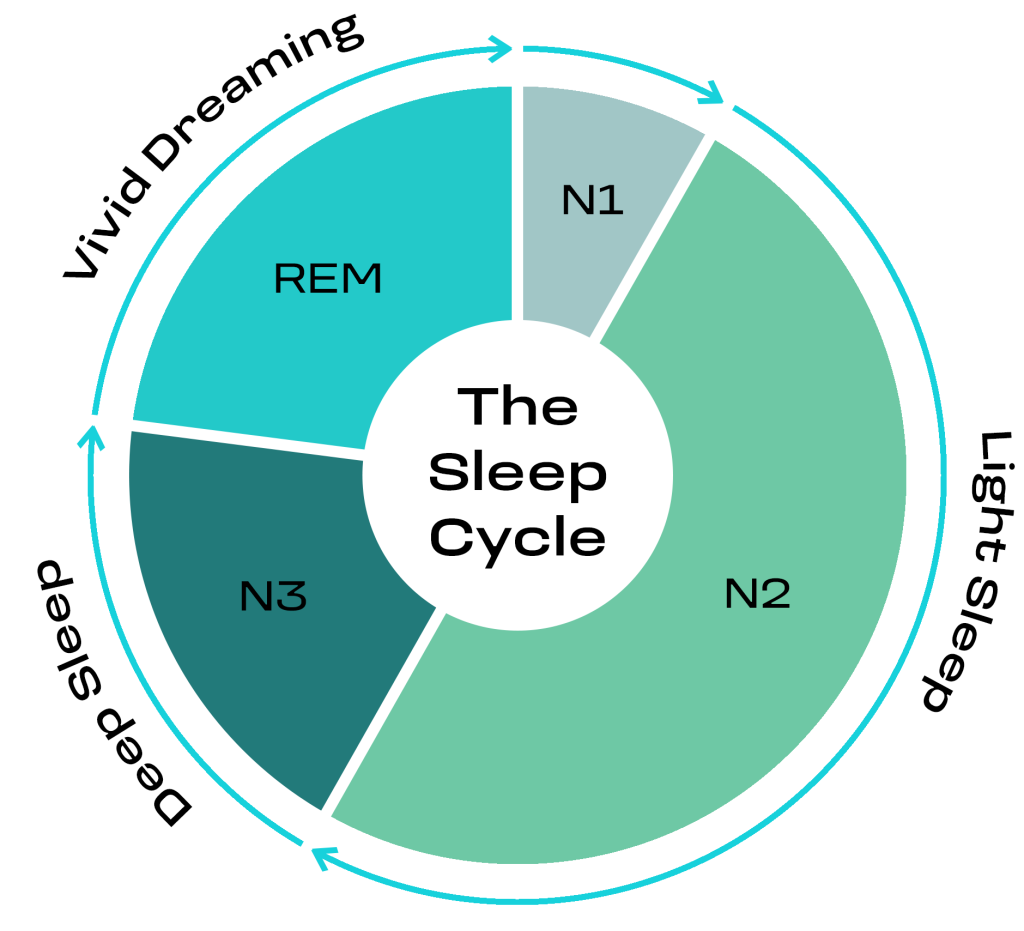
Sleep is not a uniform state but comprises multiple stages that cycle throughout the night. A complete sleep cycle lasts approximately 90 to 120 minutes and is made up of two easily distinguishable neurophysiological states: rapid eye movement (REM) and non-rapid eye movement (NREM) (3).

A typical night includes four to six of these cycles, with each containing two key phases:

  • Non-Rapid Eye Movement (NREM) sleep
  • Rapid Eye Movement (REM) sleep
Diagram of sleep cycle stages including NREM and REM sleep, showing transitions through light, deep, and REM sleep during a full 90-minute cycle.

Light Sleep (NREM Stage 1–2): The Starting Point for Restorative Sleep

Light sleep is the first stage where your body begins its transition from wakefulness into deeper rest.

During this stage, your muscles begin to relax, your heart rate slows, and your core temperature drops, signalling to your body that it’s time for sleep (2).

Why Light Sleep Matters:

  • Prepares the body for deep and REM sleep
  • Regulates breathing, heart rate, and temperature
  • Supports overall sleep efficiency and restfulness

Without enough light sleep, transitioning into deep and REM sleep becomes difficult, leading to grogginess and poor recovery, even after a full night’s rest (2).

Deep Sleep (NREM Stage 3): Where Physical Recovery Takes Place

Also known as slow-wave sleep, this phase is essential for body repair and immune system function (4). During this stage, your body releases growth hormones, repairs muscle and tissue, and recharges your energy.

But deep sleep isn’t just about the body – it’s critical for the brain too. This stage plays a key role in memory consolidation, helping you process and retain new information (6). Whether you’re physically active, recovering from illness, or need sharp mental focus, deep sleep is when your body and brain do their most important work.

Male athlete using a massage gun for muscle recovery after a workout, promoting physical recovery and better sleep through post-exercise relaxation.

Key Benefits of Deep Sleep:

  • Supports muscle repair and tissue growth
  • Boosts the production of immune-fighting proteins (cytokines) (4)
  • Helps consolidate memory and learning (6)(7)
  • Promotes cell regeneration and hormonal balance


Without enough deep sleep, your body and brain can’t recover effectively, leaving you sluggish, foggy, and under-recovered.

REM Sleep: The Brain’s Most Active Sleep Phase

REM (Rapid Eye Movement) sleep is the most mentally stimulating phase of your sleep cycle. It’s when your brain is highly active, processing emotions, memories, and information from the day (7)(8). It’s also when dreaming occurs.

Despite high brain activity, your body experiences muscle atonia, a form of temporary paralysis, preventing you from physically acting out your dreams.

REM sleep isn’t just about dreaming – it’s crucial for cognitive function and emotional regulation. It enhances problem-solving abilities, strengthens memory, and boosts creativity (7). Additionally, REM sleep plays a key role in maintaining mood stability, helping you process emotions and avoid irritability (8). Without enough REM sleep, you may feel mental fog, emotional imbalance, and difficulty staying focused.

Sleep Dreams

Benefits of REM Sleep:

  • Enhances problem-solving, learning, and emotional processing
  • Boosts creativity and cognitive function
  • Helps maintain mental clarity and mood stability
  • Crucial for emotional resilience and memory retention

Since REM sleep occurs mostly in the second half of the night, cutting sleep short can reduce time spent in this vital stage, leaving you feeling mentally drained and emotionally unsettled the next day.

How Many Sleep Cycles Should You Get Per Night?

Most adults experience four to six sleep cycles per night, depending on total sleep duration. Because each cycle lasts roughly 90 to 120 minutes, getting fewer than seven hours of sleep often means cutting one or more cycles short.

This matters because deep sleep occurs more heavily in the earlier cycles, while REM sleep dominates the later ones. When sleep is shortened, REM sleep is usually sacrificed first – which can impact mood, focus, creativity, and emotional resilience the next day.

Rather than aiming for a specific number of cycles, the goal should be allowing your body enough uninterrupted time to complete full cycles naturally. Consistency and sleep quality matter just as much as total hours.

Why Balanced Sleep Cycles Matter for Optimal Health

Each sleep stage plays a distinct role, but it’s the balance between them that really makes the difference. If any stage is shortened, whether from stress or disruptions, it can result in:

  • Incomplete recovery
  • Poor mental focus
  • Emotional imbalance
  • Weakened immunity

Moving through complete sleep cycles multiple times per night is essential for waking up refreshed, clear-headed, and energised (7).

How to Optimise Your Sleep Cycles

Now that you understand the basics, let’s talk about how you can enhance your sleep quality.

1. Maintain a Consistent Sleep Schedule

Go to bed and wake up at the same time daily – even on weekends. This helps regulate your circadian rhythm, allowing smoother sleep cycle transitions (2).

2. Create a Sleep-Friendly Environment

Make your bedroom cool, dark, and quiet. Use blackout curtains, a white noise machine, or a sleep mask.

Warm, dimly lit bedroom with soft pillows and a nightstand lamp, creating a calming sleep environment for a healthy nighttime routine.

3. Reduce Blue Light Exposure

The blue light emitted by phones and laptops can disrupt melatonin production, a hormone crucial for sleep. Reducing screen exposure at least an hour before bed can help ease your body into a deeper, more restorative sleep.

4. Wind Down Before Bed

Engage in calming activities like reading or taking a warm bath. For extra support, Night Blend’s natural ingredients help reduce stress and support your body’s transition into restful sleep.

Support Your Sleep Cycles with HAKD HEALTH’s Night Blend

Understanding your sleep cycles is the first step. Supporting them is where Night Blend comes in.

Formulated with 15 clinically backed, all-natural ingredients, Night Blend works in harmony with your body to:

  • Help you fall asleep faster
  • Improve deep and REM sleep duration
  • Reduce night wakings and stress
  • Leave you feeling refreshed and clear-headed in the morning

Woman in bed wearing a sleep mask after taking HAKD Health Night Blend, a natural cherry-flavoured sleep supplement for better nighttime recovery.

Whether you’re an athlete, entrepreneur, or simply someone who values their sleep, Night Blend is your ally in achieving consistent, high-quality rest. No grogginess. No restless nights. Just deep, restorative sleep that fuels your day.

Take Control of Your Sleep Tonight

Your goals don’t wait. Neither should your sleep.

Upgrade your nights with science-backed sleep support from HAKD HEALTH.

Shop Night Blend Now

References:

Sleep Science // Episode 5
Deep Sleep

Deep sleep is where real recovery happens.
Not just rest - repair.

This is the phase where the body does its heaviest overnight work:
physical recovery, nervous system reset, and brain clean-up.

When deep sleep is disrupted, you can get enough hours - and still wake up feeling flat.

This episode breaks down why deep sleep is so critical, and what actually influences how much you get.

Sleep quality isn’t about time in bed.
It’s about what happens while you’re there.

Tune in next week for the next part of the series.
...

22 5

Road to Hyrox: Founder Edition

Episode 4 - Check-In (Part 2)

Night time routines.
Implementing Night Blend.
Most feared Hyrox component.
And more.

The sit-down continues.

Weekly episodes.
Follow the journey.
...

23 3

Do all you Hyrox athletes agree?
Our founder and first time Hyrox-er, Mark, explaining how he is going to set his 1km pace during his Hyrox in March.

Would love to hear your thoughts!

#hyrox
...

1 0

Road to Hyrox: Founder Edition

Episode 4 - Check-In (Part 1/2)

Progress isn’t made in workouts.
It’s made in the habits that support them.

The honeymoon phase is over.
This is where discipline replaces motivation.

A sit-down check-in on training, routine, and recovery.

Part 2 coming next.

Weekly episodes.
Follow the journey.
...

34 3

Sleep Science // Episode 4
Falling Asleep

Feeling tired isn’t what makes you fall asleep.
Biology does.

This episode looks at the signals that control the transition from awake to asleep - and why being exhausted doesn’t always mean you’ll drift off.

If that process is under-supported, falling asleep takes longer.

Sleep isn’t about willpower.
It’s about timing and biology.
...

24 1

Ever wondered why you still feel tired even after a full night’s sleep? The answer might lie in your sleep cycles.

Sleep isn’t one continuous state – it’s made up of distinct phases your body cycles through during the night. These sleep stages play a vital role in everything from brain health to physical recovery (1)(5). Many people experience poor sleep simply because they don’t understand how these cycles work or how to support them.

In this article, we’ll break down the science of sleep cycles, why they matter, and how you can optimise your sleep, naturally and effectively, with help from Night Blend.

What Are Sleep Cycles?

Sleep cycles are repeating patterns your brain and body move through during the night. Each cycle contains different stages of sleep that support physical recovery, brain function, memory, and emotional regulation. Moving through these cycles smoothly and completely is essential for waking up feeling rested and restored.

Sleep is not a uniform state but comprises multiple stages that cycle throughout the night. A complete sleep cycle lasts approximately 90 to 120 minutes and is made up of two easily distinguishable neurophysiological states: rapid eye movement (REM) and non-rapid eye movement (NREM) (3).

A typical night includes four to six of these cycles, with each containing two key phases:

  • Non-Rapid Eye Movement (NREM) sleep
  • Rapid Eye Movement (REM) sleep
Diagram of sleep cycle stages including NREM and REM sleep, showing transitions through light, deep, and REM sleep during a full 90-minute cycle.

Light Sleep (NREM Stage 1–2): The Starting Point for Restorative Sleep

Light sleep is the first stage where your body begins its transition from wakefulness into deeper rest.

During this stage, your muscles begin to relax, your heart rate slows, and your core temperature drops, signalling to your body that it’s time for sleep (2).

Why Light Sleep Matters:

  • Prepares the body for deep and REM sleep
  • Regulates breathing, heart rate, and temperature
  • Supports overall sleep efficiency and restfulness

Without enough light sleep, transitioning into deep and REM sleep becomes difficult, leading to grogginess and poor recovery, even after a full night’s rest (2).

Deep Sleep (NREM Stage 3): Where Physical Recovery Takes Place

Also known as slow-wave sleep, this phase is essential for body repair and immune system function (4). During this stage, your body releases growth hormones, repairs muscle and tissue, and recharges your energy.

But deep sleep isn’t just about the body – it’s critical for the brain too. This stage plays a key role in memory consolidation, helping you process and retain new information (6). Whether you’re physically active, recovering from illness, or need sharp mental focus, deep sleep is when your body and brain do their most important work.

Male athlete using a massage gun for muscle recovery after a workout, promoting physical recovery and better sleep through post-exercise relaxation.

Key Benefits of Deep Sleep:

  • Supports muscle repair and tissue growth
  • Boosts the production of immune-fighting proteins (cytokines) (4)
  • Helps consolidate memory and learning (6)(7)
  • Promotes cell regeneration and hormonal balance


Without enough deep sleep, your body and brain can’t recover effectively, leaving you sluggish, foggy, and under-recovered.

REM Sleep: The Brain’s Most Active Sleep Phase

REM (Rapid Eye Movement) sleep is the most mentally stimulating phase of your sleep cycle. It’s when your brain is highly active, processing emotions, memories, and information from the day (7)(8). It’s also when dreaming occurs.

Despite high brain activity, your body experiences muscle atonia, a form of temporary paralysis, preventing you from physically acting out your dreams.

REM sleep isn’t just about dreaming – it’s crucial for cognitive function and emotional regulation. It enhances problem-solving abilities, strengthens memory, and boosts creativity (7). Additionally, REM sleep plays a key role in maintaining mood stability, helping you process emotions and avoid irritability (8). Without enough REM sleep, you may feel mental fog, emotional imbalance, and difficulty staying focused.

Sleep Dreams

Benefits of REM Sleep:

  • Enhances problem-solving, learning, and emotional processing
  • Boosts creativity and cognitive function
  • Helps maintain mental clarity and mood stability
  • Crucial for emotional resilience and memory retention

Since REM sleep occurs mostly in the second half of the night, cutting sleep short can reduce time spent in this vital stage, leaving you feeling mentally drained and emotionally unsettled the next day.

How Many Sleep Cycles Should You Get Per Night?

Most adults experience four to six sleep cycles per night, depending on total sleep duration. Because each cycle lasts roughly 90 to 120 minutes, getting fewer than seven hours of sleep often means cutting one or more cycles short.

This matters because deep sleep occurs more heavily in the earlier cycles, while REM sleep dominates the later ones. When sleep is shortened, REM sleep is usually sacrificed first – which can impact mood, focus, creativity, and emotional resilience the next day.

Rather than aiming for a specific number of cycles, the goal should be allowing your body enough uninterrupted time to complete full cycles naturally. Consistency and sleep quality matter just as much as total hours.

Why Balanced Sleep Cycles Matter for Optimal Health

Each sleep stage plays a distinct role, but it’s the balance between them that really makes the difference. If any stage is shortened, whether from stress or disruptions, it can result in:

  • Incomplete recovery
  • Poor mental focus
  • Emotional imbalance
  • Weakened immunity

Moving through complete sleep cycles multiple times per night is essential for waking up refreshed, clear-headed, and energised (7).

How to Optimise Your Sleep Cycles

Now that you understand the basics, let’s talk about how you can enhance your sleep quality.

1. Maintain a Consistent Sleep Schedule

Go to bed and wake up at the same time daily – even on weekends. This helps regulate your circadian rhythm, allowing smoother sleep cycle transitions (2).

2. Create a Sleep-Friendly Environment

Make your bedroom cool, dark, and quiet. Use blackout curtains, a white noise machine, or a sleep mask.

Warm, dimly lit bedroom with soft pillows and a nightstand lamp, creating a calming sleep environment for a healthy nighttime routine.

3. Reduce Blue Light Exposure

The blue light emitted by phones and laptops can disrupt melatonin production, a hormone crucial for sleep. Reducing screen exposure at least an hour before bed can help ease your body into a deeper, more restorative sleep.

4. Wind Down Before Bed

Engage in calming activities like reading or taking a warm bath. For extra support, Night Blend’s natural ingredients help reduce stress and support your body’s transition into restful sleep.

Support Your Sleep Cycles with HAKD HEALTH’s Night Blend

Understanding your sleep cycles is the first step. Supporting them is where Night Blend comes in.

Formulated with 15 clinically backed, all-natural ingredients, Night Blend works in harmony with your body to:

  • Help you fall asleep faster
  • Improve deep and REM sleep duration
  • Reduce night wakings and stress
  • Leave you feeling refreshed and clear-headed in the morning

Woman in bed wearing a sleep mask after taking HAKD Health Night Blend, a natural cherry-flavoured sleep supplement for better nighttime recovery.

Whether you’re an athlete, entrepreneur, or simply someone who values their sleep, Night Blend is your ally in achieving consistent, high-quality rest. No grogginess. No restless nights. Just deep, restorative sleep that fuels your day.

Take Control of Your Sleep Tonight

Your goals don’t wait. Neither should your sleep.

Upgrade your nights with science-backed sleep support from HAKD HEALTH.

Shop Night Blend Now

References:

Ever wondered why you still feel tired even after a full night’s sleep? The answer might lie in your sleep cycles.

Sleep isn’t one continuous state – it’s made up of distinct phases your body cycles through during the night. These sleep stages play a vital role in everything from brain health to physical recovery (1)(5). Many people experience poor sleep simply because they don’t understand how these cycles work or how to support them.

In this article, we’ll break down the science of sleep cycles, why they matter, and how you can optimise your sleep, naturally and effectively, with help from Night Blend.

What Are Sleep Cycles?

Sleep cycles are repeating patterns your brain and body move through during the night. Each cycle contains different stages of sleep that support physical recovery, brain function, memory, and emotional regulation. Moving through these cycles smoothly and completely is essential for waking up feeling rested and restored.

Sleep is not a uniform state but comprises multiple stages that cycle throughout the night. A complete sleep cycle lasts approximately 90 to 120 minutes and is made up of two easily distinguishable neurophysiological states: rapid eye movement (REM) and non-rapid eye movement (NREM) (3).

A typical night includes four to six of these cycles, with each containing two key phases:

  • Non-Rapid Eye Movement (NREM) sleep
  • Rapid Eye Movement (REM) sleep
Diagram of sleep cycle stages including NREM and REM sleep, showing transitions through light, deep, and REM sleep during a full 90-minute cycle.

Light Sleep (NREM Stage 1–2): The Starting Point for Restorative Sleep

Light sleep is the first stage where your body begins its transition from wakefulness into deeper rest.

During this stage, your muscles begin to relax, your heart rate slows, and your core temperature drops, signalling to your body that it’s time for sleep (2).

Why Light Sleep Matters:

  • Prepares the body for deep and REM sleep
  • Regulates breathing, heart rate, and temperature
  • Supports overall sleep efficiency and restfulness

Without enough light sleep, transitioning into deep and REM sleep becomes difficult, leading to grogginess and poor recovery, even after a full night’s rest (2).

Deep Sleep (NREM Stage 3): Where Physical Recovery Takes Place

Also known as slow-wave sleep, this phase is essential for body repair and immune system function (4). During this stage, your body releases growth hormones, repairs muscle and tissue, and recharges your energy.

But deep sleep isn’t just about the body – it’s critical for the brain too. This stage plays a key role in memory consolidation, helping you process and retain new information (6). Whether you’re physically active, recovering from illness, or need sharp mental focus, deep sleep is when your body and brain do their most important work.

Male athlete using a massage gun for muscle recovery after a workout, promoting physical recovery and better sleep through post-exercise relaxation.

Key Benefits of Deep Sleep:

  • Supports muscle repair and tissue growth
  • Boosts the production of immune-fighting proteins (cytokines) (4)
  • Helps consolidate memory and learning (6)(7)
  • Promotes cell regeneration and hormonal balance


Without enough deep sleep, your body and brain can’t recover effectively, leaving you sluggish, foggy, and under-recovered.

REM Sleep: The Brain’s Most Active Sleep Phase

REM (Rapid Eye Movement) sleep is the most mentally stimulating phase of your sleep cycle. It’s when your brain is highly active, processing emotions, memories, and information from the day (7)(8). It’s also when dreaming occurs.

Despite high brain activity, your body experiences muscle atonia, a form of temporary paralysis, preventing you from physically acting out your dreams.

REM sleep isn’t just about dreaming – it’s crucial for cognitive function and emotional regulation. It enhances problem-solving abilities, strengthens memory, and boosts creativity (7). Additionally, REM sleep plays a key role in maintaining mood stability, helping you process emotions and avoid irritability (8). Without enough REM sleep, you may feel mental fog, emotional imbalance, and difficulty staying focused.

Sleep Dreams

Benefits of REM Sleep:

  • Enhances problem-solving, learning, and emotional processing
  • Boosts creativity and cognitive function
  • Helps maintain mental clarity and mood stability
  • Crucial for emotional resilience and memory retention

Since REM sleep occurs mostly in the second half of the night, cutting sleep short can reduce time spent in this vital stage, leaving you feeling mentally drained and emotionally unsettled the next day.

How Many Sleep Cycles Should You Get Per Night?

Most adults experience four to six sleep cycles per night, depending on total sleep duration. Because each cycle lasts roughly 90 to 120 minutes, getting fewer than seven hours of sleep often means cutting one or more cycles short.

This matters because deep sleep occurs more heavily in the earlier cycles, while REM sleep dominates the later ones. When sleep is shortened, REM sleep is usually sacrificed first – which can impact mood, focus, creativity, and emotional resilience the next day.

Rather than aiming for a specific number of cycles, the goal should be allowing your body enough uninterrupted time to complete full cycles naturally. Consistency and sleep quality matter just as much as total hours.

Why Balanced Sleep Cycles Matter for Optimal Health

Each sleep stage plays a distinct role, but it’s the balance between them that really makes the difference. If any stage is shortened, whether from stress or disruptions, it can result in:

  • Incomplete recovery
  • Poor mental focus
  • Emotional imbalance
  • Weakened immunity

Moving through complete sleep cycles multiple times per night is essential for waking up refreshed, clear-headed, and energised (7).

How to Optimise Your Sleep Cycles

Now that you understand the basics, let’s talk about how you can enhance your sleep quality.

1. Maintain a Consistent Sleep Schedule

Go to bed and wake up at the same time daily – even on weekends. This helps regulate your circadian rhythm, allowing smoother sleep cycle transitions (2).

2. Create a Sleep-Friendly Environment

Make your bedroom cool, dark, and quiet. Use blackout curtains, a white noise machine, or a sleep mask.

Warm, dimly lit bedroom with soft pillows and a nightstand lamp, creating a calming sleep environment for a healthy nighttime routine.

3. Reduce Blue Light Exposure

The blue light emitted by phones and laptops can disrupt melatonin production, a hormone crucial for sleep. Reducing screen exposure at least an hour before bed can help ease your body into a deeper, more restorative sleep.

4. Wind Down Before Bed

Engage in calming activities like reading or taking a warm bath. For extra support, Night Blend’s natural ingredients help reduce stress and support your body’s transition into restful sleep.

Support Your Sleep Cycles with HAKD HEALTH’s Night Blend

Understanding your sleep cycles is the first step. Supporting them is where Night Blend comes in.

Formulated with 15 clinically backed, all-natural ingredients, Night Blend works in harmony with your body to:

  • Help you fall asleep faster
  • Improve deep and REM sleep duration
  • Reduce night wakings and stress
  • Leave you feeling refreshed and clear-headed in the morning

Woman in bed wearing a sleep mask after taking HAKD Health Night Blend, a natural cherry-flavoured sleep supplement for better nighttime recovery.

Whether you’re an athlete, entrepreneur, or simply someone who values their sleep, Night Blend is your ally in achieving consistent, high-quality rest. No grogginess. No restless nights. Just deep, restorative sleep that fuels your day.

Take Control of Your Sleep Tonight

Your goals don’t wait. Neither should your sleep.

Upgrade your nights with science-backed sleep support from HAKD HEALTH.

Shop Night Blend Now

References: